
Why the best strategy sometimes comes from crafting
Executive Summary:
Leaving the comfort zone: Anyone seeking radically new perspectives in business must deliberately break away from familiar thought patterns.
Overcoming blockages: Personal hurdles from childhood (such as undiscovered ambidextrie or old gender roles) can be turned into real strengths in adulthood.
Tactile balance: Working with your hands relieves purely mental work and unleashes fresh ideas that would never arise in front of empty slides.
True role model function: Leadership and mindset mean living the practice of leaving comfort zones yourself, rather than just preaching theoretical concepts
Introduction
For years, my professional world consisted of complex business cases, strategy papers, and endless Excel spreadsheets. At the end of a long workday, I had done a lot of thinking, analyzing, and structuring. But I had nothing tangible in my hands.
That felt familiar, because the cognitive realm was my safe harbor. The creative, hands-on side, on the other hand, was a forbidden zone for me for decades. Until I realized that this is precisely where the key to better decisions and fresh ideas in daily business lies.
The blockage from childhood and the ambidextrous brain
As a child, I hated art class. I was considered clumsy and felt completely uncreative. What no one explained to me back then: My brain was simply wired differently. Being ambidextrous, my motor skills and pen control were confused during my early years. Where other children quickly developed a dominant hand, my system needed more time.
Added to this was the spirit of the 80s and 90s. Crafting, painting, and creative design were simply not popular among boys. The logic was quickly formed: I can’t do this, it doesn’t suit me. A mental barrier was drawn.
Why true innovation needs mental work that doesn’t use the mind
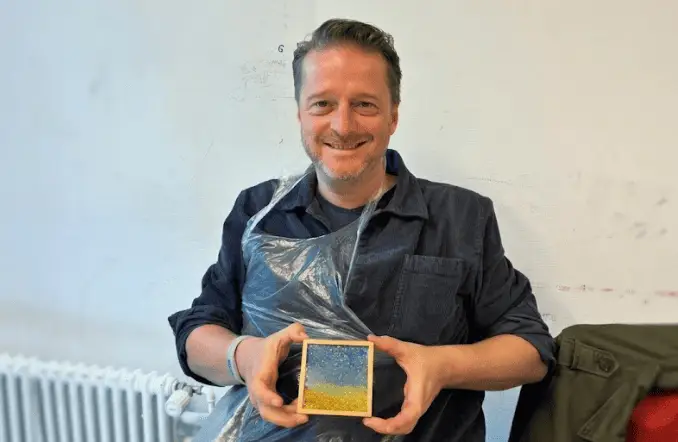
Recently, I sat in a workshop again. This time wearing a plastic apron, surrounded by paints and resin. The first few minutes? Pure effort. I still catch myself trying to cover up initial insecurities with jokes.
Yet as soon as the focus shifts from purely rational analysis to tactile creation, something neurological happens: The mind switches gears. The brain leaves the highway mode of familiar thought patterns.
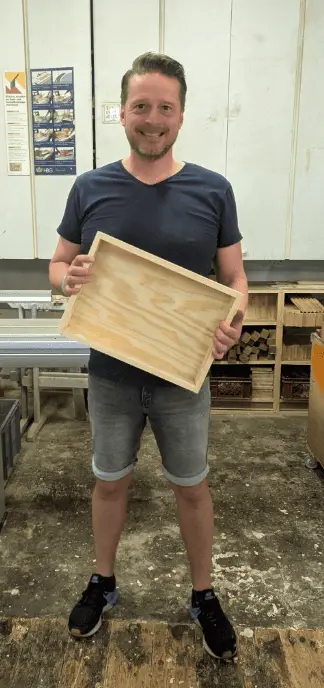
The result isn’t just about the product in your hands. It affects the mind. My best ideas for new keynotes, workshops, and business formats rarely come from staring frantically at an empty PowerPoint slide. They arise when we give the brain a completely unconventional impulse, whether through woodworking, painting ceramics, or pouring resin.
Leadership means leading by example, not preaching
Anyone who expects flexibility, courage for novelty, and stepping out of the comfort zone from their teams must take these steps themselves. It is not enough to quote change management from textbooks.
If we want to see real results in business, we must be willing to endure small doses of uncertainty. Trying out new paths without a guarantee of a perfect outcome is precisely the training that keeps us capable of acting during complex business challenges.
Conclusion
True resilience and creative problem solving in business do not originate in theory. They happen in practice, when we allow ourselves to be beginners again. Leaving your comfort zone feels uncomfortable at first, but rewards you with new perspectives you would never have found at your desk.
When was the last time you consciously left your comfort zone to gain fresh ideas for your daily business?
If you and your team are looking for new impulses to break through ingrained thought patterns and achieve real results: Let’s talk. In my keynotes and workshops, we combine proven strategies with genuine eye-opening moments.
