

Not every employee is a dandelion (and that’s a good thing)
Don’t worry, this isn’t a new blog for hobby gardeners. This is still about leadership, company culture, and true resilience on the job. However, a metaphor from developmental psychology simply explains a costly problem in many teams best.
Executive Summary:
- The problem: Inflexible work environments often assess employees based on rigid presence or sheer stamina rather than actual performance. Orchids (people with specific needs such as HSPs, parents without a support network, neurodivergent individuals, or non-conformists) are falsely labeled as low performers or difficult.
- The consequences: Quiet quitting, high absenteeism, negative Glassdoor reviews, and massive damage to the employer brand.
- The solution: Leaders must take a bird’s-eye view. It is not about special treatment for individuals, but about flexible framework conditions that allow different personalities to bloom.
- The business impact: Tailored conditions increase innovative power, reduce turnover costs, and strengthen employer branding sustainably.
The misunderstanding in the flower bed
In many companies, an unwritten law still prevails: those who are loudest, sit in the office the longest, and smile through every high-pressure phase deliver the best performance.
The image of the robust dandelion that grows everywhere often serves as a hidden benchmark. Dandelion employees are valuable. They cope with constant restructuring, need little guidance, and simply function on any soil.
But what happens to the others? The orchids?
An orchid withers on concrete. However, if it receives the right light, the appropriate humidity, and the right temperature, it produces a splendor of blossoms that overshadows everything else. In organizations, leaders waste enormous potential because they treat orchids like stubborn weeds instead of adapting the environment.
The concept originally goes back to the developmental pediatrician Thomas Boyce, who describes in his research how differently people react to their environment. This insight can be translated one-to-one for the modern world of work.
What orchids really need and what missing out costs
1. Who are the orchids in modern teams?
Orchid is not a label for low performance. It is a synonym for people whose full productivity is linked to certain framework conditions:
The non-conformists with edges and corners: In cultures characterized by high conformity, they stand out because they ask uncomfortable questions. They are not contrarians on principle, but often possess a strong sense of justice and a fine intuition for wrong developments. If they are not cut down, but heard, they bring the essential critical mass for true innovation.
Highly sensitive persons (HSPs) and neurodivergence: In noisy open-plan offices, a large part of their energy is wasted on simple stimulus processing. In quiet focus zones or at home, they often deliver above-average creative and analytically strong results.
The cultural color mismatch (e.g., according to DISC): Many organizations are strongly shaped by red (goal-driven) and blue (structure-fixed) behaviors. A yellow employee (creative, associative, relationship-oriented) is quickly labeled as unstructured in such an environment. Their strengths as bridge builders and idea suppliers wither if the system only rewards hard KPIs.
Employees with mental health challenges: Those who struggle in the morning with high cortisol levels or phases of anxiety do not need a lecture because they are five minutes late checking in. Flexible working hours allow these specialists to deliver peak performance when their nervous system is stable.
Parents without a support network: Those who have the daycare closing time breathing down their neck at 3:00 PM and cannot engage grandparents or nannies suffer from artificial pressure. This has nothing to do with a lack of motivation, but with a lack of organizational flexibility on the part of the employer.
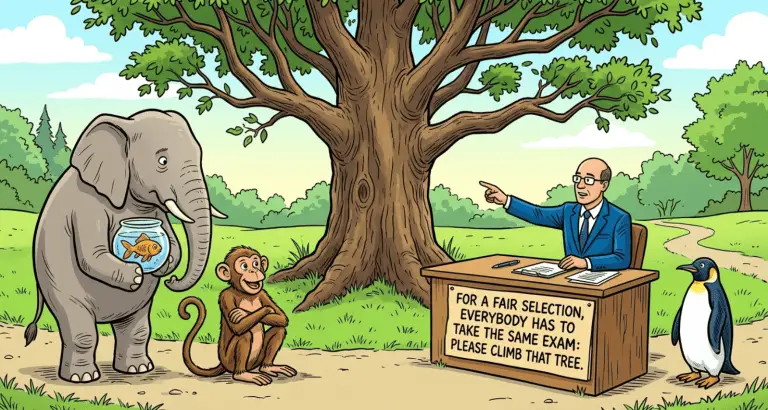
2. The deficit view and its costly consequences
When someone on the team is not performing, a quick reflex often takes hold: “they don’t want to” or “they can’t”. Blame is sought immediately within the individual instead of questioning the system.
Since terminations are often complex, a dangerous downward spiral emerges. Those affected are dragged along, ignored, or in the worst case, subtly bullied out. The consequences for the company are dramatic:
Quiet quitting and absenteeism: People who constantly have to fight against the wrong environment burn out. Sick leave increases.
Damage to the employer brand: Ex-employees rarely leave quietly. The bill follows on rating platforms like Glassdoor or within private networks. Lines like “only presence counts here, no empathy” end up costing the HR team a huge part of the budget for talent acquisition.
Collapse of psychological safety: The entire team observes how supposedly weak colleagues are dealt with. The result is a culture of fear where no one admits mistakes or takes risks anymore.
3. The task of modern leadership: Creating frameworks instead of handing out special favors
Resilience in the company does not mean raising everyone to be hardened dandelions. Yet, it also does not mean introducing bureaucratic special treatment for every employee.
Modern leadership means taking a bird’s-eye view and setting intelligent, flexible guardrails. A team made up entirely of dandelions often overlooks fine nuances and risks. Only the interplay between the robustness of the dandelion and the depth, empathy, and innovative power of the orchid makes an organization crisis-proof.
Conclusion: The environment decides the value
When a plant does not bloom, you do not repair the plant. You change the soil it stands on.
Companies that understand that performance is the result of fitting framework conditions win twice over: they retain valuable specialists, reduce turnover costs, and create a work environment that exerts real attraction on the job market.
Your next step for a strong company culture
From my many years of experience in international corporations, I know how strong the operational pressure is in daily work. I know the dynamics on both sides: how difficult this change of perspective often is in management, and what it does to people when the environment is not right. I set in exactly at this interface.
As a keynote speaker and workshop leader, I support HR managers and decision-makers in sharpening awareness for different potentials and inspiring leaders for a modern, resilient culture. Let us work together to ensure that in your teams, both dandelions and orchids bloom sustainably.
