

The Invisible Balance Sheet: Why Mental Health Absences are a Business Risk
Executive Summary:
Mental health conditions account for almost 18% of all sick leave in Germany, with an increase of over 40% since 2012.
A single day of absence by a manager or specialist costs the company up to €1,200, including lost productivity.
In addition to direct wage costs, there are massive indirect costs arising from the increased workload on remaining team members and a decline in psychological safety.
Long recovery periods of 30 to 40 days are usually caused by the delay in addressing symptoms and masking them in the workplace.
Strategic prevention is a business necessity for minimising risk and directly maintaining productivity.
In corporate management, we rely on what is measurable. But one of the most massive burdens on productivity does not appear directly in any quarterly report: the costs of neglecting our mental health. Those who dismiss this as a purely private matter underestimate the economic impact on the entire company.
The Hard Facts: A Systemic Record High
Mental illnesses are now responsible for nearly 18 % of all sick days in Germany. That is almost every fifth day of absence. Looking at the development over the last ten years, we see an increase of over 40 %. This is not a temporary phenomenon but a structural risk for modern organizations.
A crucial difference from physical problems is the duration. While an average case of illness lasts about 15 days, the average for mental diagnoses is over 30 to 40 days. These cases often drag on for months, which massively jeopardizes planning reliability in projects.
The Direct Cost Calculation of a Day of Absence
The often quoted 400 euros per day of absence is merely an average value. For managers and highly specialized roles, the calculation looks much more alarming:
- Specialists and Management: Here, the costs for a single day of absence including missed value creation, project delays, and administrative effort are between 800 and 1,200 euros.
- Replacement: Refilling a key position after long term disability costs the company between 50 % and 100 % of a gross annual salary through recruiting fees and onboarding times.
The Invisible Avalanche: Indirect Costs
The direct loss is only the beginning. The true costs often arise in the remaining team. When a top performer fails, the work is distributed among colleagues. This triggers a dangerous chain reaction. The additional work leads to stress for the healthy ones. The error rate increases and general motivation decreases. A team that sees a valued colleague collapse begins to doubt its own future in the company. The willingness to fluctuate increases.
The Dark Figure: Self Medication and Addiction Risks
A topic often kept quiet in executive suites is the connection between psychological pressure and substance abuse. Chronic stress often leads to self medication in practice. Statistics show that a significant proportion of mental health burdens is associated with risky alcohol consumption or the abuse of medication. This means a double risk for the company.
The danger of accidents increases and the quality of decisions drops drastically before the employee officially fails. This presenteeism costs companies often more than the actual absence.
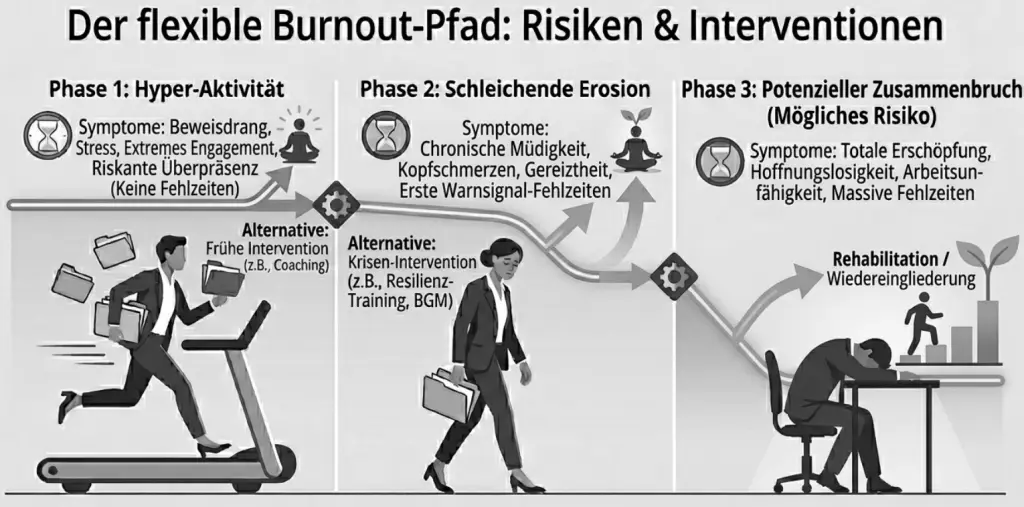
Why the Absence is so Profound: The Three Phases
The reason healing takes so long is the delaying of symptoms. Usually, the path into the crisis is gradual:
- Hyper Activity: The employee tries to compensate for internal deficits by working even more. Stress is misunderstood as fuel.
- Creeping Erosion: First physical warning signs are covered with caffeine, painkillers, or alcohol. The error rate increases while masking consumes the last reserves.
- Total Collapse: Only when nothing works anymore does the sick leave occur. The system is then already in deep exhaustion.
Prevention as Strategic Risk Management
Those who wait until a top performer collapses in Phase 3 have already lost from a business perspective. Investments in an open corporate culture and the removal of taboos regarding mental health burdens are not a feel good extra. It is hard risk management. The calculation is simple. A targeted expert impulse that enables dialogue in Phase 1 or 2 costs only a fraction of a single month long burnout absence of a manager.
Conclusion of the Management Expert: A healthy employee is a valuable asset. An employee who falls ill due to a lack of prevention is an avoidable liability in the balance sheet.
Quellen und Referenzen
- Statista Dossier 2025: Psychische Erkrankungen (BAuA, BMG, DAK, BKK, Deutsche Rentenversicherung).
- AXA Mind Health Report 2025: Globale Daten zu Ursachen und zum psychischen Gesundheitszustand weltweit.
- Statistisches Bundesamt (Destatis): Krankheitskosten und Sterberaten aufgrund psychischer Störungen.
- DAK Gesundheitsreport 2024: Analysen zur Dauer und Verteilung von Diagnosen.
